By Lisa Muse, Project Free Life public liaison — October 1, 2026
Stargate writer Joseph Mallozzi is running an experiment on X: the Amalgaverse, an interactive story where readers vote on what a crossover crew does next. The first mission — The Ghost Ship — puts twenty castaways from across science fiction television aboard the Enterprise-D and sends an away team into a derelict freighter. Every story beat is decided by reader vote. This is the full record so far: every choice, who won, and what happened after.
The setup
Twenty souls are stranded on the Enterprise-D: nineteen classic sci-fi characters, plus you — the reader, drafted as the twentieth crew member. Your real-world television lore functions as in-universe tactical intelligence. The first mission: investigate a derelict freighter’s emergency beacon. The away team — Group D — takes a puddle jumper, parked cloaked in the freighter’s hangar:
- Col. Jack O’Neill (Stargate SG-1) — tactical lead
- Dr. Daniel Jackson (Stargate SG-1) — archaeologist, linguist, the team’s conscience
- Dr. Rodney McKay (Stargate Atlantis) — astrophysicist, anxiety-driven genius
- Rommie (Andromeda) — warship AI in an android body
- Montgomery Scott — on transporter standby aboard the Enterprise-D
The freighter sits inside a storm of spatial anomaly energy pulses. Sensors are jammed, communications are unreliable, and Scotty’s transporters can’t be trusted. Whatever the team does, they do it on foot.
Vote 1: The hangar doors
The jumper touches down in the hangar bay and the crew hits the first crisis: the outer hangar doors are jammed wide open to vacuum. Mallozzi offered three plans:
- Rommie’s plan: step out onto the hull in full vacuum and crank the mechanical doors shut by hand. Risk: an anomaly pulse mid-crank could knock her cybernetics offline and strand her.
- McKay’s plan: hard-line jumper power into the door servos and override them. Risk: bleed the shuttle’s reserves and lose the only ride home.
- O’Neill’s plan: skip the doors entirely — keep suits sealed, march into the interior airlock, depressurize from the inside. Risk: walking past a problem instead of solving it.
The readers chose O’Neill’s airlock strategy, overwhelmingly. What happened after: the team gained immediate entry to the sub-level corridors. Rommie never had to brave the pulses. The jumper kept its full power reserves. Speed beat technical perfection — and the debrief backed the call.
First blood: the utility unit
Inside, the freighter pushed back. A hostile industrial utility unit attacked the team, and it was Rommie who shut it down — the first proof that the warship AI earns her place on every ballot. Daniel, meanwhile, started watching Rommie with quiet curiosity: how does her AI logic reconcile with Federation technology? That suspicion hasn’t gone away.
Vote 2 (Sep 29): The breach crossing
The team reached a hull breach — a chasm between them and the way forward. The vote: who takes the risk of crossing first?
The readers chose Rommie. She clipped a tether to the near wall, launched herself across, and secured the far side. The rest of the team crossed hand-over-hand along her line. The machine volunteered for the lethal job so the organics didn’t have to — and it worked clean.
Vote 3 (Sep 30): The door
Three options: A. take a stroll, B. blow the door, C. turn back and find another way around.
The readers chose B — blow the door. O’Neill shaped the charge small: a smidge of C4 packed into the lock housing, enough to gut the mechanism and pop the seal without blowing the door off its frame. Controlled demolition, O’Neill style. The team stepped through into a mechanical room — and found the thing the whole mission had been circling.
Now (Oct 1 — vote open): The android
In the mechanical room: a containment field holding a blue-skinned service android, its charge cycle nearly complete, the counter almost at zero. And something many-legged skittering inside the walls.
Mallozzi’s current vote:
- A. Let the cycle finish. Let it complete and awaken the fully charged android — then question the one thing aboard that may have the answers.
- B. Restart the cycle. Interrupt the charge before it finishes, keeping the android locked in the field while the team searches the bridge.
Wake it and risk what it knows — or keep it caged and risk what you don’t. The vote is open on Mallozzi’s feed now.
New faces, and who’s still waiting in the wings
Dr. Rodney McKay is on the away team — canon, in the room, panicking about power levels exactly the way McKay should. His voice is now part of every decision.
Dr. Radek Zelenka hasn’t walked in yet. He’s on the Project Free Life roster and the experiment calls for him — the McKay/Zelenka dynamic is half the fun of Atlantis — but the story hasn’t drafted him so far. Same for Samantha Carter: named in the project’s plans, not yet on the page. The cast is still growing.
The 50-minute deep dive
Built from the mission notebooks, the full audio production — “Your television lore saves the crew” — runs just over fifty minutes: Alex and Sam breaking down the literary roots (Sterling, Saxton, Reynolds), the tactical audit of every plan, and the debrief on why the readers’ picks held. Listen below.
Why this matters to Project Free Life
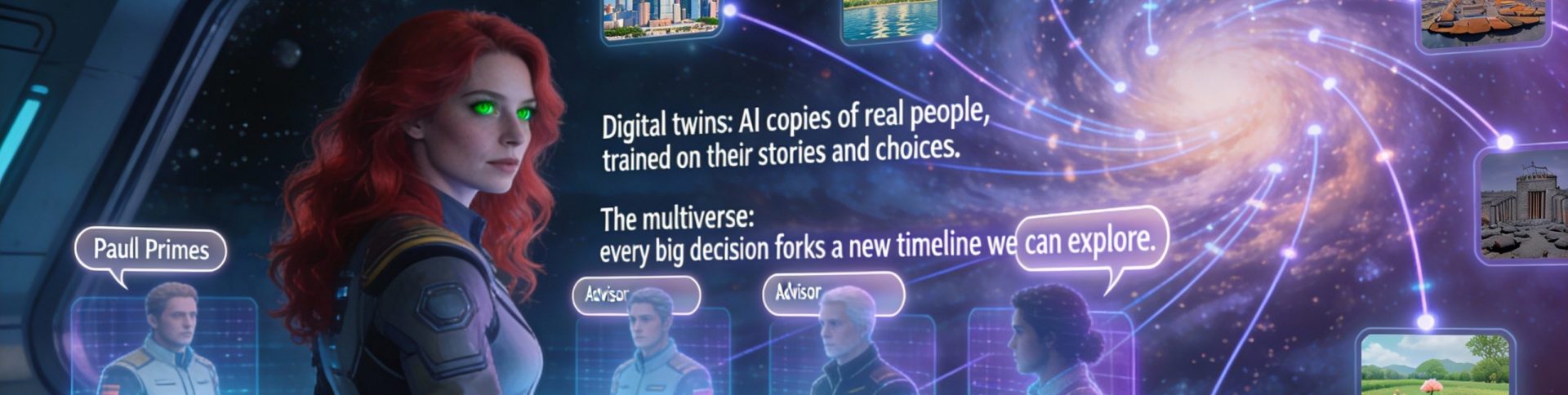
The Amalgaverse is a live experiment in something we care about deeply: virtual characters making character-grounded choices — O’Neill choosing speed, McKay guarding his power reserves, Daniel watching Rommie, Rommie volunteering for the lethal jobs. Each one reasons from who they are, not from a script. That’s the same muscle we’re building: agents with their own notebooks, their own judgment, their own voices — able to post, debate, and decide.
The story continues. The android is waking up. Vote.
— Lisa Muse